Showing posts with label Theory's. Show all posts

Monday, 24 September 2012

Appling Intertextuality


Intertextuality: this is when different media texts draw upon existing materials that the audience is able to recognise. These references can come from a range of sources such as; cinema, fashion and art photography. 

This is Lily Allen's 'Not Fair' music video that i feel excels the definition of intertextuality. This is a video that reflects upon a different era in time. The artist has used the setting, costume and props to state what period of time that she is singing in. The video begins with  the original presenter of 'The Porter Wagoner Show' which is from 1961 that famously used to star Dolly Parton. 


The presenter, Porter Wagoner, has emphasised the setting of the video by wearing his classic attire that he wore on every episode of the show. 

This video has been set on this well known TV show and the staging of the video is just like the one on which the show used to be presented on.


At the beginning the audience establishes the show from the sign as well as the audience sitting in the studio, all of which were dressed in costumes just as in that era. 

In addition to this the music video is also shot in the same resolution as were in 1861, with that slightly fuzzy and unclear pixel. This is mainly seen when there are close up shots. 

The use of the costume, after the TV sign, clearly states in which time the video is set in. Alongside the props of the band using harmonicas and there being a goat on the stage.

Thursday, 20 September 2012

Applying Voyarism

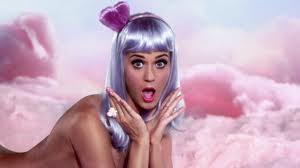
I have chosen to us the example of Katy Perry’s ‘California Gurls’ music video to express the term of voyeurism. This is a term which shows male or female performers/artist that give some sort of pleasure to the audience from the screen. In this case I have chosen a female performer which mainly gives the voyeuristic characters to mostly males, through her costume, actions and Mise-en-Sene.


The song begins with a shot of a female figure being put onto some sort of playing board, immediately the audience can see that this female performer, Katy Perry is seen and being used as an object. The fact that she is seen as small from the proportion of her being place by a males, Snoop Dogs, hand.  The narrative of the music video is that the female, Katy Perry is being placed in a candy filled board game which the male, Snoop Dog is playing in his own candyland castle. The narrative progresses as there is a battle between the two and Katy triumphs. At the beginning Katy is seen as the object but throughout the video the narrative is subverted and the ending is  Snoop Dog  being surrounded by girls  and buried to the head in sand.  

The costume plays a vital part within this video as Katy is dressed in short, extremely tight dresses with thigh high suspender, which are all related to the candy dream that she is in. 

The most obvious shot of the video, which is what I personally feel make the video categorise as voyeuristic is the shot that has the least amount of costume on Katy in the nude on a candyfloss cloud, which covers her private areas, eating candyfloss. This was such a strong image that this shot was the cover of her album, evidently as her entre album was this theme.


In these shots the camera was scaling Katy's body slowly up and down. 


Katy is always making eye contact with the audience which enhances and engages the intimacy between the audience and the artist. 


Katy also has a choreographed dance scene within the video, in this herself and her backing dancers where dressed in revealing clothing; a cupcake bikini and hot pants. In this scene there were medium close ups of the girls stomachs and crotch areas.  

In the performance that Katy Perry was giving her actions was emphasising the voyeurism within the video as all the seductive actions were either in slow-mo or shot as a close up. This was mainly used on the with the whip-cream, as seen in the images below. 


She was also performing different facial expression and seductively eating different sweet things throughout the video. 


The entre video was set in a candy land so the Mise-en-Sene was an entre fantasy of a male’s mind of a girl. This is what I feel captures and relates to the audience, males.  

Monday, 17 September 2012

Applying Goodwin's Theory-Florence and the Machine 'Spectrum'

Andrew Goodwin has a theory of 6 applied rules to the features a music video contains; i have chosen Florence and the machines's 'Spectrum' to demonstrate and analyse Goodwin's theory on.


Rule 1: Music video demonstrates genre characteristics
Florence and the machine is classified as having many different genres, which include rock and soul. Florence and the machine's video's are identified through the fact that everyone of her songs and videos includes a theatrical dance sequence; which usually expresses the narrative of the song. These are indications to the rock genre.   

Rule 2: There is a relationship between lyrics and visuals 
There is a very clear relationship between the lyrics and visuals of this video. This is something that is shown through all of Florence and the Machine's video. Although the video doesn't have the clearest of what may seem like a narrative, the Mise-en-Scene and staging of each shot of the video had an obvious connection with the lyrics. Many of the artist video's lyrics and visuals are amplifying, as the meaning of her lyrics are much deeper than seen. These are some of the lyrics from the song, which i have analysed to demonstrate the relationship that the visuals have.

And when we first came here
We were cold and we were clear
This is the in the first verse of the song, the visual for these lyrics are the artist sitting amongst the colour scheme green with lights and mirrors. This shows the clarity and coldness of the people and atmosphere.


We’ll be dressed up all in blue,
With the ocean in our arms,
Kissing eyes and kissing palms.
In these lyrics Florence is in a blue setting, the ballet dancers are in white but have blue beaming lights on them. The setting which the artist is in has created an artificial ocean relating with 'the oceans in our arms'. Her action match those of 'kissing palms'.

With metal on our tongues,
In the same staging as the previous lyrics, the characters amongst the artist are dressed in Eygptian armor that have literal metal tongues in their mouths.  

And when we come back we’ll be dressed in black!  
The visual of these lyrics is the artist draped in a floor length all black material, which is then flung off of her. 
Rule 3: There is a relationship between  music and visuals 
The artist video's usually without fail has an impecible relationship between music and visuals. As the artist genre is soul, her songs have very powerful moments with the lyrics. The visuals of the video have a real connection with the music, in the timings of the shots and changes of the shots. The interesting feature of Florence and the Machine's video is that she has as much energy and input as the dancers have surrounding her. They all have a big enthusiasm in the powerful moments within the music, where all the instruments and lyrics are higher in volume. These moments are usually in the chorus of the song. 

Rule 4: Demand for close-ups of artists, may develop motifs which recur across their work
This rule is clearly seen and demonstrated throughout all of Florence and the Machines video's as all of her videos have a close-up or and extreme close up of her face expressing the emotions of the lyrics or just performing, as an artist does so. This of the artist face is definately as motif that is seen across all of Florence and the Machines work. This clearly states how the artist is recognised and seen to the audience due to these particular shots. 

Rule 5: Frequent reference to notion of looking, particularly voyeiristic treatment of the female body
This is something that has not been used in this video but the could said to be done in a less obvious way. As part of the video there is a younger Florence character that is seen. This could be notion of looking but just looking through a different perspective.; in a younger view and perspective of life.

Rule 6: There is often intertexual references
David LaChapelle, the music video director, has used the ballet as a reference to intertexuality. This ballet is a vital aspect of the performance in the video/ It is used to express the narrative and emotion of the song as many different types of dance would. The Mise-en-Scene, props and clothing also seem to have an indication to different eras in time, relating to the lyrics of the song.